Power Terminals Installation Considerations and Guidelines
The following information should be read and understood before proceeding with any electrical installation of the drive.
Power Supply Connections
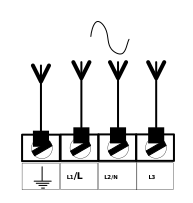
It is recommended that the power cabling should be 4-core PVC-insulated screened cable, and laid in accordance with local industrial regulations and codes of practice.
The cables should be dimensioned according to any local codes or regulations.
Suitable fuses to provide wiring protection of the input power cable should be installed in the incoming supply line, recommended ratings are given in the Topic Drive Circuit Protection. The fuses must comply with any local codes or regulations in place. In general, type gG (IEC 60269) or UL type T fuses are suitable; however, in some cases type aR fuses may be required. The operating time of the fuses must be below 0.5 seconds.
A fixed installation is required according to IEC61800-5-1 with a suitable disconnecting device installed between the drive and the AC Power Source. The disconnecting device must conform to the local safety code / regulations (e.g. within Europe, EN60204-1, Safety of machinery).
Where allowed by local regulations, suitably dimensioned type B MCB circuit breakers of equivalent rating may be utilised in place of fuses, providing that the clearing capacity is sufficient for the installation.
The maximum permissible short circuit current at the drive Power terminals as defined in IEC60439-1 is 100kA.
When the power supply is removed from the drive, a minimum of 30 seconds should be allowed before re-applying the power. A minimum of 10 minutes should be allowed before removing the terminal covers or connection.
An optional Input Choke/Line reactor is recommended to be installed in the supply line for drives where any of the following conditions occur:
The incoming supply impedance is low or the fault level / short circuit current is high
The supply is prone to dips or brown outs
An imbalance exists on the supply (3 phase drives)
The power supply to the drive is via a busbar and brush gear system
In all other installations, an input choke is recommended to ensure protection of the drive against power supply faults.
Motor Connections
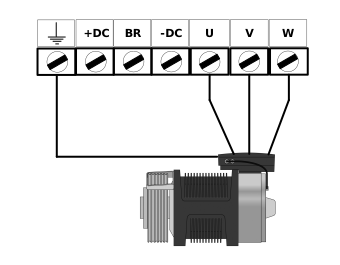
There are sometimes multiple connections within the motor terminal box, in general: Star and Delta. It is essential to ensure that the motor is connected in accordance with the voltage at which it will be operated.
Maximum Motor cable length for shielded type cables is 100m/330ft (150m/495ft for un-shielded cables).
NOTE: The maximum motor cable length stated is the maximum permissible cable length for the drive hardware and does not take into consideration EMC compliance.
The motor earth must be connected to one of the drive earth terminals.
The cable screen should be terminated at the motor end using an EMC type gland allowing connection to the motor body through the largest possible surface area.
The PWM output switching from any inverter when used with a long motor cable length can cause an increase in the voltage at the motor terminals, depending on the motor cable length and inductance. The rise time and peak voltage can affect the service life of the motor. Invertek Drives Ltd recommend using an output choke for motor cable lengths of 50m or more to ensure good motor service life.
The motor must be connected to the drive U, V, and W terminals using a suitable 3 or 4 core cable. Where a 3 core cable is utilised, with the shield operating as an earth conductor, the shield must have a cross sectional area at least equal to the phase conductors when they are made from the same material. Where a 4 core cable is utilised, the earth conductor must be of at least equal cross sectional area and manufactured from the same material as the phase conductors.
For compliance with the European EMC directive, a suitable screened (shielded) cable should be used. Braided or twisted type screened cable where the screen covers at least 85% of the cable surface area, designed with low impedance to HF signals are recommended as a minimum. Installation within a suitable steel or copper tube is generally also acceptable.
Where drives are mounted in a steel control panel enclosure, the cable screen should be terminated directly to the control panel using a suitable EMC clamp or gland, as close to the drive as possible.